 English
 中文
中文 Русский
 Deutsch
 Français
 日本語
日本語 Indonesia
 Tiếng Việt
 ไทย
ไทย العربية
Panduan Memilih Generator Diesel untuk Konstruksi di Nigeria 2026
By Kylin Lin, Senior Power Systems Engineer at Ningde Kinger Electrical Machinery Co., Ltd. (KIGERPOWER)
Published: September 2026 | Sourcing Category: West Africa Construction Power Equipment
Executive Summary: Navigating Power Demands on Nigerian Job Sites
For civil engineering contractors, commercial developers, and industrial equipment importers operating across Lagos, Abuja, Port Harcourt, and Kano, reliable electric power is not merely a convenience—it is the lifeline of project execution. Nigeria’s national electrical grid experiences frequent total system collapses, delivering less than 4,500 MW of power for a population exceeding 220 million. Consequently, virtually 100% of commercial construction machinery operates on prime, off-grid generator power.
Operating generating sets in West Africa presents unique environmental and logistical challenges: ambient temperatures exceeding 40°C, high relative humidity along the Gulf of Guinea, abrasive dust during the Harmattan season, variable fuel quality in Automotive Gas Oil (AGO), and strict SONCAP import standards.
This 2026 sourcing guide provides project engineers and procurement managers with a factual roadmap for specifying, importing, and maintaining heavy-duty commercial diesel generator sets engineered specifically for Nigerian job sites.
1. The West African Grid Reality: Prime Power vs. Standby Duty
In Western markets, generators are primarily sold as “standby” units designed for 50 to 100 hours of emergency backup per year. In Nigeria, generators operate as continuous prime power units running 12 to 24 hours daily on commercial job sites.
- Prime Power Rating (PRP): The maximum power a generator can deliver continuously under variable electrical loads for unlimited hours annually, with a 10% overload capability for 1 hour in every 12 hours.
- Standby Power Rating (ESP): The maximum power available during a power outage for emergency use only—generators should never be run continuously at this rating.
- Sourcing Rule: When purchasing Chinese-manufactured generator sets from manufacturing hubs like Ningde, always specify the Continuous Prime Rating (PRP) rather than the peak standby number on the model badge.
2. Fuel Quality & Filtration: Managing High-Sulfur Automotive Gas Oil (AGO)
Automotive Gas Oil (AGO) distributed in Nigeria can have variable sulfur levels, micro-particulate rust from storage tanks, and water contamination from high tropical humidity condensation.
Essential Factory Fuel System Specifications:
- Two-Stage Fuel Filtration: Standard factory single filters are inadequate. Demand a heavy-duty primary fuel-water separator filter with a transparent sediment bowl and drain valve, backed by a secondary 5-micron spin-on diesel filter.
- Direct-Injection Mechanical Fuel Pumps: For remote West African job sites, mechanical fuel injection systems (such as high-pressure inline pumps) tolerate variable fuel quality significantly better than ultra-delicate electronic common-rail (HPCR) systems that require ultra-low sulfur diesel (ULSD) unavailable outside major cities.
- Sub-Base Fuel Tanks: Specify high-capacity base fuel tanks providing at least 10 to 12 hours of continuous run-time at 75% load, reducing the risk of fuel contamination during frequent manual drum refills.
3. Ambient Temperature & Derating: Sizing for 40°C+ and High Humidity
Standard international ISO 8528 generator ratings assume an ambient temperature of 25°C, altitude below 1,000 meters, and 30% relative humidity. In northern Nigeria (Kano, Maiduguri) during the hot season, ambient temperatures frequently exceed 42°C. In coastal Lagos, relative humidity regularly tops 85%.
Engineering Derating Formula:
$$ ext{Derating Factor} = 1 - \left[0.03 imes rac{(T_{ ext{ambient}} - 25)}{5} ight]$$
For an ambient temperature of 40°C: $$ ext{Derating Factor} = 1 - \left[0.03 imes rac{15}{5} ight] = 1 - 0.09 = 0.91\ (91%\ ext{available capacity})$$
A generator rated at 10 kW in a temperature-controlled laboratory delivers approximately 9.1 kW continuous power on a hot Nigerian job site. Always size your equipment with a 15% to 20% capacity buffer to prevent high-temperature tripping.
4. Alternator Engineering: 100% Copper Winding vs. Aluminum
When ordering generators for export to West Africa, distributors are often tempted by lower purchase prices offered for copper-clad aluminum (CCA) or pure aluminum windings. This is a catastrophic shortcut in tropical environments:
| Engineering Dimension | 100% Pure Copper Winding (Class H) | Aluminum / Copper-Clad Aluminum (CCA) |
|---|---|---|
| Thermal Conductivity | 385 W/(m·K) — Rapid heat dissipation | 205 W/(m·K) — Heat builds up quickly |
| Electrical Resistivity | 1.68 × 10⁻⁸ Ω·m — Low internal resistance | 2.82 × 10⁻⁸ Ω·m — High internal I²R losses |
| Corrosion Resistance | Excellent in humid, salty coastal air (Lagos) | Highly prone to galvanic corrosion and oxide scaling |
| Overload Surge Handling | High thermal mass handles motor starting currents | Vulnerable to insulation breakdown and coil burnout |
| Service Life in Tropics | 10,000+ operating hours | Often fails within 800 to 1,500 hours |
At KIGERPOWER, all export-grade silent diesel generators utilize 100% pure electrolytic copper wire with Class H vacuum pressure impregnation (VPI) insulation, ensuring long-term resilience against humidity, salt air, and heavy motor starting currents.
5. Nigerian Sizing Matrix: Construction Site Equipment
| Equipment Load | Running Watts (kW) | Starting Surge (kW) | Minimum Recommended Generator |
|---|---|---|---|
| Reversible Concrete Mixer (500L) | 4.5 kW | 11.5 kW | KIGERPOWER KG15000DE (12 kW Silent Diesel) |
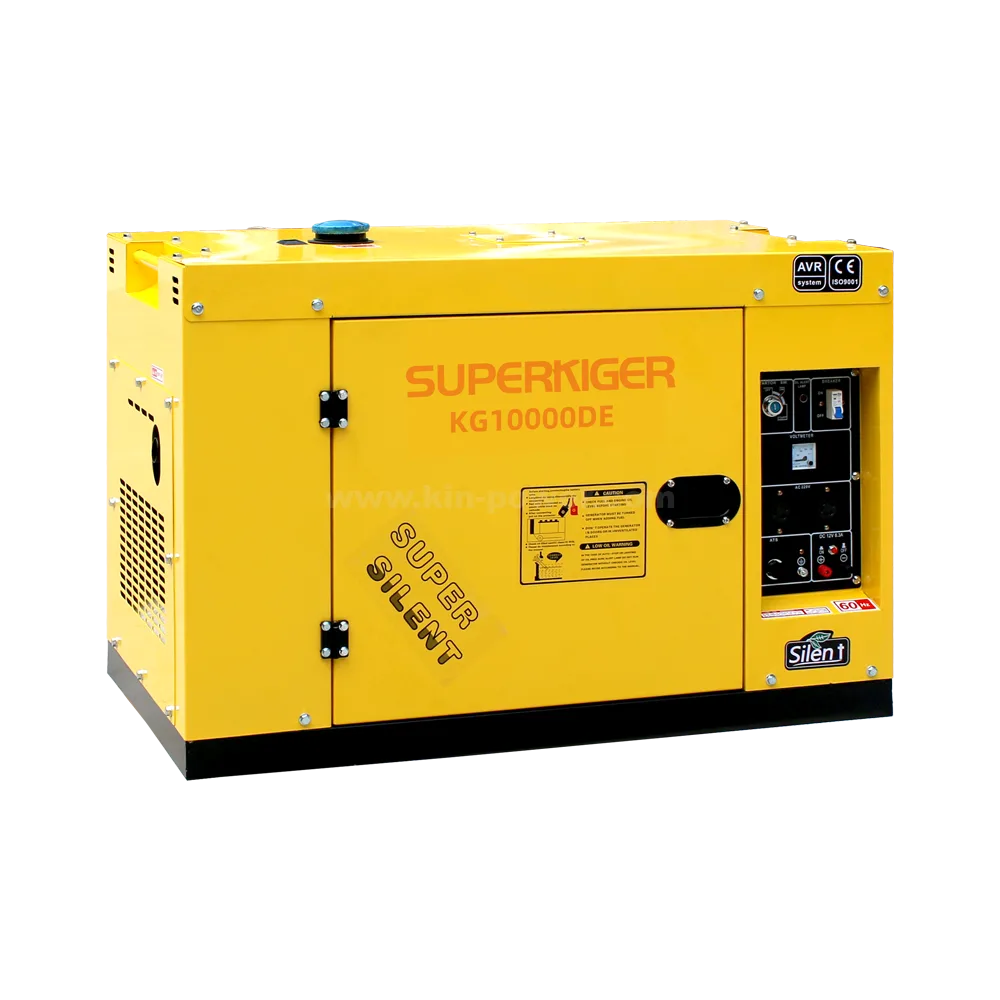
| Submersible De-watering Pump (3-inch) | 2.2 kW | 6.5 kW | KIGERPOWER KG10000DE (8–10 kW Silent Diesel) |
| Inverter Welding Machine (200A) | 5.0 kW | 7.5 kW | KIGERPOWER KG10000DE (8–10 kW Silent Diesel) |
| Site Office Container (AC + Lights) | 3.5 kW | 8.0 kW | KIGERPOWER KG10000DE (8–10 kW Silent Diesel) |
| Hand Power Tools (Angle Grinder, Drill) | 1.5 kW | 3.0 kW | KIGERPOWER KG5000DE (5 kW Silent Diesel) |
6. Regulatory Clearance: SONCAP (PC/SC) Import Protocol
The Standards Organisation of Nigeria (SON) enforces the Standards Organisation of Nigeria Conformity Assessment Programme (SONCAP) to prevent substandard machinery imports:
- Product Certificate (PC): Before placing production orders, ensure the manufacturer holds a valid PC (typically Route A, B, or C) issued by an authorized inspection partner (e.g., SGS, Bureau Veritas, Cotecna).
- Form M & Pre-Arrival Assessment Report (PAAR): The Nigerian importer opens an electronic Form M via an authorized commercial dealer bank.
- SONCAP Certificate (SC): Upon completion of container stuffing, the supplier submits final commercial invoices, packing lists, and test reports to generate the final electronic SC, enabling rapid port clearance at Apapa or Tin Can Island.
Technical Sizing Note: For detailed engineering calculations on motor inrush surge currents and power factor derating, refer to our companion guide: How to Size a Generator for Inductive Motor Loads.
Frequently Asked Questions (FAQ)
Q1: Why is diesel preferred over gasoline for construction equipment in Nigeria?
Safety, availability, and heavy inductive load handling. Automotive Gas Oil (AGO) diesel is widely distributed in bulk on Nigerian job sites, has a safe flash point above 52°C, and heavy diesel engines easily absorb high startup currents from concrete mixers, welding machines, and drainage pumps.
Q2: What SONCAP documentation is required to clear diesel generators at Nigerian ports?
Importers need a Product Certificate (PC) and a SONCAP Certificate (SC). A valid PC is required before shipment, followed by an SC generated from shipping documents and third-party inspection reports to clear goods through the Nigeria Single Window Trade Portal.
Q3: How does ambient temperature in Nigeria affect generator rated power output?
Generators experience thermal derating of approximately 3% per 5°C above standard 25°C rating. In Nigerian ambient conditions reaching 38°C–42°C with high humidity, always specify at least 15%–20% capacity headroom to maintain continuous rated output.
Q4: How often should fuel and oil filters be replaced when running Nigerian AGO diesel?
Every 150 to 200 operational hours. Due to variable sulfur content and sediment in local AGO fuel supplies, primary fuel-water separators should be inspected daily, and fuel filters and engine oil serviced more frequently than standard factory intervals.
Author & Engineering Support (E-E-A-T)
Author: Kylin Lin
Title: Senior Power Systems Engineer at KIGERPOWER
Organization: Ningde Kinger Electrical Machinery Co., Ltd. (KIGERPOWER)
Expertise: Over 15 years specializing in generator load testing, tropical cooling systems, and West African export standards (SONCAP, CE, ISO 9001).
For container shipment inquiries, OEM branding, or SONCAP documentation support: [email protected] | KIGERPOWER Product Catalog