 English
 中文
中文 Русский
 Deutsch
 Français
 日本語
日本語 Indonesia
 Tiếng Việt
 ไทย
ไทย العربية
Diesel vs. Gasoline Generators for Commercial Backup: The Complete 2026 Buying Guide
By Lin Kai, Senior Power Applications Engineer at Ningde Kinger Electrical Machinery Co., Ltd. (KIGERPOWER)
Published: September 2026 | Technical Category: Commercial Power Equipment & Sourcing
Executive Summary: The 2026 Commercial Power Dilemma
For facility managers, project contractors, commercial fleet operators, and industrial equipment importers, choosing between diesel and gasoline (petrol) generator sets is one of the most consequential procurement decisions. While both technologies have evolved significantly—with advanced sound-attenuated canopies, digital AVRs (Automatic Voltage Regulators), and cleaner emissions profiles—their core mechanical architectures dictate vastly different operational economics.
In 2026, shifting global fuel price ratios, stricter site safety standards, and regional compliance mandates (such as EURO-V in Europe and SONCAP across West Africa) make a simplistic “diesel is always better for business” rule obsolete.
This guide delivers an engineering-grounded, data-backed comparison between commercial-grade diesel generators (typically 2 kW to 2000 kW) and portable gasoline generators (650 W to 20 kW), providing actionable sizing, total cost of ownership (TCO), and application-specific benchmarks.
Quick Comparison: Diesel vs. Gasoline Generator Matrix
| Evaluation Dimension | Commercial Diesel Generators (e.g., KG5000DE – KG15000DE) | Commercial Gasoline Generators (e.g., KG2500 – KG13000E) | Deciding Winner / Context |
|---|---|---|---|
| Initial Acquisition Cost (CAPEX) | Higher (approx. 40%–70% premium over gasoline) | Lower (lowest cost per rated kilowatt initially) | Gasoline (Low-budget or standby-only) |
| Fuel Thermal Efficiency | 35% – 42% thermal efficiency | 25% – 30% thermal efficiency | Diesel (Burns ~30%–35% less fuel per kWh) |
| Engine Operating Lifespan | 8,000 – 15,000+ hours (prior to major overhaul) | 1,500 – 3,000 hours | Diesel (5x longer operational life) |
| RPM & Wear Rate | 1,500 / 3,000 RPM (Heavy-duty direct injection) | 3,000 / 3,600 RPM (High revving overhead valve) | Diesel (Lower piston speeds = lower fatigue) |
| Motor-Starting Surge Capacity | Exceptional (High engine block inertia & torque) | Moderate (Requires 2x–3x derating for motor surges) | Diesel (Ideal for pumps, compressors, HVAC) |
| Fuel Flashpoint & Storage Safety | > 52°C (126°F) — Non-explosive, stable storage | -43°C (-45°F) — Highly volatile, explosive vapors | Diesel (Preferred for site safety & insurance) |
| Fuel Shelf Life | 12 – 24 months (with standard biocide stabilizer) | 3 – 6 months (ethanol fuel gums carburetors) | Diesel (Long-duration commercial standby) |
| Service / Maintenance Interval | Every 200 – 250 operating hours | Every 50 – 100 operating hours | Diesel (Lower labor and filter downtime) |
| Noise Levels (Acoustic Pressure) | 68 – 72 dB(A) at 7m (with silent canopy) | 74 – 82 dB(A) at 7m (standard open frame) | Diesel Silent Canopy (Enclosed environments) |
| Cold Weather Starting (< -5°C) | Requires glow plugs, intake heaters, or block heaters | Starts readily with standard choke / carburetor | Gasoline (Simpler sub-zero cold starts) |
1. Thermodynamic & Mechanical Architecture Differences
The fundamental divergence between diesel and gasoline generators stems from their combustion cycles:
Compression Ignition (Diesel / CI)
Diesel engines operate on the Diesel thermodynamic cycle. Air is compressed inside the combustion chamber at high compression ratios (ranging from 16:1 to 22:1), raising the internal temperature above 550°C. Heavy diesel fuel is then atomized directly into the superheated air via high-pressure fuel injectors, igniting spontaneously without a spark plug.
- High Cylinder Pressures: Demands heavier forged steel crankshafts, reinforced cast-iron cylinder blocks, and robust connecting rods.
- High Low-End Torque: The long stroke and heavy rotating assembly create immense rotational inertia, allowing the generator to absorb sudden inductive electrical shock loads (e.g., inductive motor startups) without stalling or experiencing severe voltage dips.
Spark Ignition (Gasoline / SI)
Gasoline engines operate on the Otto thermodynamic cycle at lower compression ratios (typically 8.5:1 to 10.5:1). A premixed charge of air and atomized fuel is drawn into the cylinder, compressed, and ignited via a spark plug.
- Lightweight Construction: Aluminum alloy blocks and lighter reciprocating parts allow rapid acceleration and high engine speeds (3,600 RPM for 60 Hz or 3,000 RPM for 50 Hz).
- Lower Torque Density: While responsive and lightweight, gasoline generator sets experience greater RPM droop when subjected to large sudden commercial loads, requiring oversizing when sizing for inductive machinery.
2. Total Cost of Ownership (TCO): A 3-Year Commercial Analysis
Purchasing decisions should never be based solely on initial purchase price (FOB or landed cost). In commercial operations running more than 300 hours per year, fuel expenditure quickly eclipses the original capital expense.
Scenario Baseline
- Required Output: 8 kW Continuous Prime / Backup Load
- Usage Model: Light Industrial Backup / Rural Commercial Power (500 operating hours/year = 1,500 hours over 3 years)
- Equipment Evaluated:
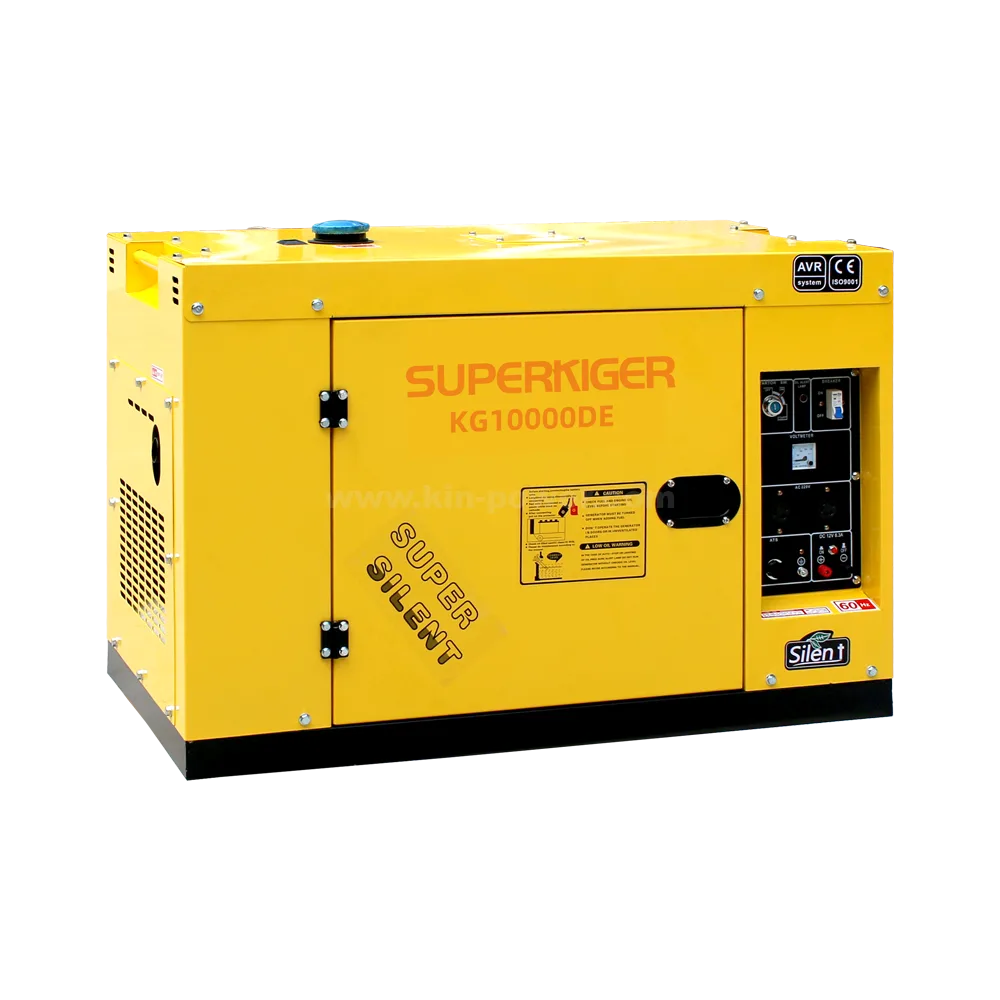
- Option A: KIGERPOWER KG10000DE (8 kW Silent Diesel Generator Set, Electric Start)
- Option B: KIGERPOWER KG13000E (8–10 kW Portable Gasoline Generator, Electric/Recoil Start)
+-----------------------------------------------------------------------------------+
| 3-Year Cumulative Operational Cost Comparison (8 kW Prime Load @ 75% Average)    |
+-----------------------------------------------------------------------------------+
| Cost Component                 | 8 kW Silent Diesel Set  | 8 kW Gasoline Set      |
+--------------------------------+-------------------------+------------------------+
| Initial Machine Purchase (CAPEX)| $1,450                  | $780                   |
| Fuel Consumption per Hour      | 1.95 L/hr               | 3.20 L/hr              |
| Total Fuel (1,500 Hours)       | 2,925 Liters            | 4,800 Liters           |
| Fuel Cost (@ $1.15/L Avg.)     | $3,363.75               | $5,520.00              |
| Maintenance & Consumables      | $320 (6 oil/filter changes) | $680 (15 services+plugs) |
| Residual Asset Value (Yr 3)    | -$650 (High resale)     | -$150 (Near EOL)       |
+--------------------------------+-------------------------+------------------------+
| NET 3-YEAR COMMERCIAL COST     | $4,483.75               | $6,830.00              |
+--------------------------------+-------------------------+------------------------+
| 3-Year Net Savings with Diesel : $2,346.25 (34.3% Lower TCO)                      |
+-----------------------------------------------------------------------------------+
The Economic Tipping Point
For businesses operating their backup power under 150 hours annually (strictly emergency backup for short outages), gasoline generators offer the lowest net cash outlay due to their low entry cost. However, once annual run hours exceed 250 to 300 hours, the superior fuel efficiency and extended service intervals of diesel generators completely amortize the initial price delta.
3. Application-Specific Sourcing Recommendations
When to Specify Commercial Diesel Generators
- Construction & Infrastructure Job Sites: Heavy tools—including concrete mixers, submersible drainage pumps, welding machines, and air compressors—feature high inrush starting currents. Diesel generators absorb these inductive surges effortlessly. Furthermore, job sites typically ban volatile gasoline storage due to fire codes.
- Telecommunications Base Stations & Server Closets: Telecom cell towers often operate in remote environments requiring autonomous run-times of 24–72 hours. Diesel’s lower consumption, combined with high-capacity sub-base fuel tanks and low fuel degradation, makes it the standard specification.
- Hotels, Clinics, & Residential Commercial Complexes: When noise attenuation is required, silent diesel generators equipped with double-layer soundproof canopies, acoustic rock wool, and residential-grade silencers achieve 68–72 dB(A) at 7 meters—significantly quieter than high-revving open-frame gasoline units.
- Export Operations to Sub-Saharan Africa and the Middle East: In regions like Nigeria, Kenya, and Iraq, automotive gas oil (diesel) is significantly more accessible, subsidized, or stable in supply than high-octane petrol. Factory models with SONCAP certification, dual-frequency (50/60Hz), and tropical-duty radiator/cooling systems are essential.
When to Specify Commercial Gasoline Generators
- Mobile Service Vans & Mobile Trade Contractors: Where equipment must be lifted in and out of pickup trucks or utility vans daily, gasoline generators (weighing 35 kg to 85 kg) offer unmatched physical mobility compared to diesel sets (which typically exceed 150 kg).
- Intermittent / Emergency Standby for Retail Stores & Offices: If the local electrical grid experiences only 2 to 4 brief outages per month, the capital efficiency of a gasoline generator makes financial sense.
- Severe Cold Climate Emergency Units: In regions where ambient temperatures frequently dip below -15°C (5°F), gasoline engines ignite without block heaters or fuel anti-gel additives, whereas diesel fuel requires winterized blends (No. 1 Diesel) to prevent paraffin wax gelling in fuel filters.
4. Factory Sourcing & Container Optimization Insights
For overseas wholesale distributors and brand owners ordering from Chinese manufacturing hubs (such as Ningde, Fujian):
- Packaging & Cubing for Freight Efficiency:
Open-frame gasoline generators (e.g., 2kW–3kW models) pack compactly, allowing up to 1,500+ units per 40HQ container. Conversely, sound-attenuated silent diesel generators (such as the KG5000DE series) measure approximately
950 × 560 × 730 mmand allow 108 to 144 units per 40HQ container. Mixing container allocations between portable gasoline generators and heavy silent diesel units is often the most cost-effective way to maximize container weight and volume limits. - Certification Verification: Always demand third-party test reports validating that diesel units comply with CE directives (Machinery Directive 2006/42/EC and Low Voltage Directive 2014/35/EU) and ISO 9001 quality management, alongside local clearance documentation (such as SONCAP PC/SC for Nigeria or EURO-V emissions for EU territories).
- 100% Load-Bank Testing: Commercial-grade factory production lines should never ship units based on sample testing alone. Ensure your supplier performs full run-in and 100% rated-load bank verification (testing voltage stability, frequency regulation under AVR, and low-oil pressure shutdown protection) prior to export crating.
Regional Engineering Specs: For West Africa construction requirements, see our Nigeria Diesel Generator Sourcing Guide; for high-humidity ASEAN operations, read our Southeast Asia Tropical Cooling Guidelines.
Frequently Asked Questions (FAQ)
Q1: Is a diesel generator really more fuel-efficient than a gasoline generator?
Yes. Diesel generators consume approximately 30% to 35% less fuel by volume than comparable gasoline generators producing the same kilowatt output. Diesel fuel possesses a higher energy density (approx. 38.6 MJ/liter vs. 34.8 MJ/liter for gasoline), and compression-ignition engines operate at significantly higher thermal efficiency (up to 42% vs. 25%–30% in spark-ignition engines).
Q2: Which generator type has a higher surge capacity for starting heavy electric motors?
Diesel generators offer superior surge capacity. Because diesel engines operate with heavier cast-iron blocks, large crankshafts, and massive flywheels, they possess higher rotational inertia. When high-inductive loads (such as submersible pumps, air conditioning compressors, or industrial saws) demand 2.5x to 3x their rated running watts upon startup, a diesel engine maintains engine speed without stalling, whereas a gasoline generator often suffers voltage collapse unless substantially oversized.
Q3: Can a portable gasoline generator run continuously for 24 hours?
Generally, no. Most small, air-cooled gasoline generators are designed for intermittent duty cycles of 4 to 8 hours, requiring cooling downtime between fuel refills. Running an air-cooled gasoline generator non-stop can cause valve recession, excessive cylinder head temperatures, and oil breakdown. For continuous 24/7 commercial power, water-cooled or heavy-duty air-cooled silent diesel generators running at controlled RPMs are engineered specifically for multi-day prime power duty.
Q4: Why do commercial site managers and fire codes prefer diesel fuel over gasoline?
Safety and volatility. Gasoline has an extremely low flash point of -43°C (-45°F), meaning it emits flammable vapors at ambient temperatures that can ignite from a single spark. Diesel has a flash point above 52°C (126°F), meaning it does not create explosive vapor clouds at room temperature. Most commercial building basements, marine vessels, and industrial job sites strictly restrict bulk gasoline storage due to municipal fire codes and property insurance stipulations.
Q5: How often do diesel and gasoline generators require oil and filter maintenance?
Commercial gasoline generators typically require engine oil changes every 50 to 100 operational hours, along with regular spark plug inspection and carburetor cleaning. Commercial diesel generators feature larger oil sump capacities and heavy-duty filtration systems, extending routine oil and filter service intervals to 200 to 250 operational hours, substantially reducing lifetime maintenance labor and downtime.
Author & Editorial Authority (E-E-A-T)
Author: Lin Kai
Title: Senior Applications & Export Engineer
Organization: Ningde Kinger Electrical Machinery Co., Ltd. (KIGERPOWER)
Background: Over 15 years of technical experience in the design, load testing, and global export of gasoline and silent diesel generating sets. Having overseen OEM/ODM production lines manufacturing over 350,000 power equipment units annually shipped to 80+ countries across Africa, Southeast Asia, the Middle East, and Europe, Lin Kai specializes in commercial power sizing, acoustic canopy engineering, and international customs compliance (CE, SONCAP, ISO 9001).
For technical inquiries, OEM specifications, or container loading schedules, contact the engineering team at [email protected] or explore the KIGERPOWER Product Catalog.