 English
 中文
 Русский
 Deutsch
 Français
 日本語
 Indonesia
 Tiếng Việt
 ไทย
 العربية

Generator Fuel Consumption Chart & L/h Calculator Guide (1kW–12kW Gasoline vs. Diesel)
Share to WeChat Moments
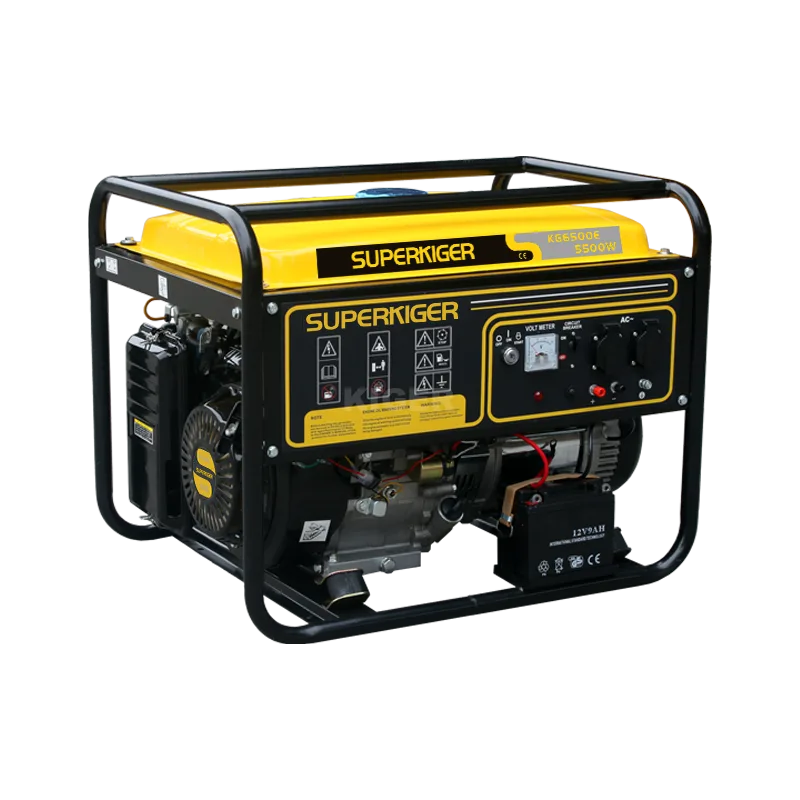
Understanding exact generator fuel consumption in liters per hour (L/h) and gallons per hour (Gal/h) is critical when calculating emergency backup fuel reserves, job-site operating budgets, or 3-year Total Cost of Ownership (TCO) for telecom and commercial projects. Manufacturer brochures frequently list only a single “maximum tank runtime” figure without specifying whether that runtime was measured at 25% load, 50% load, or full rated output.
In this engineering reference guide, the power systems team at Ningde Kinger Electrical Machinery CO.,LTD. (SUPERKIGER) breaks down the thermodynamic Brake Specific Fuel Consumption (BSFC) formulas and provides a verified 1kW to 12kW generator fuel consumption chart across 25%, 50%, 75%, and 100% load steps for open-frame gasoline, variable-speed silent inverter, and direct-injection silent diesel generators.
1. The Engineering Formula: How to Convert BSFC (g/kW·h) into Liters per Hour (L/h)
Every internal combustion engine is rated on a dynamometer by its Brake Specific Fuel Consumption (BSFC)—the mass of fuel in grams burned to produce one kilowatt-hour (g/kW·h) or one horsepower-hour (g/HP·h) of mechanical shaft power. To convert factory datasheet BSFC numbers into real-world liters per hour (L/h) at the electrical sockets, you must account for alternator conversion efficiency ($\eta_{\text{alt}} \approx 0.82 - 0.88$) and liquid fuel density ($\rho$):
$$\text{Fuel Consumption (L/h)} = \frac{P_{\text{elec (kW)}} \times \text{BSFC (g/kW}\cdot\text{h)}}{\eta_{\text{alt}} \times \rho_{\text{fuel (g/L)}}}$$
- 4-Stroke OHV Gasoline Engines (KG160 / KG200 / KG390):
- Factory BSFC:
290 g/HP·h(≈ 395 g/kW·hmechanical) - Unleaded Gasoline Density ($\rho$):
730 – 750 g/Lat 15°C - Specific Volumetric Factor at Full Load:
≈ 0.60 – 0.63 L per kWhof electrical output
- Factory BSFC:
- 4-Stroke Direct-Injection Diesel Engines (KG186FA / KG1100F / 2V92):
- Factory BSFC:
280 g/kW·hmechanical - #0 Light Diesel Oil Density ($\rho$):
830 – 850 g/Lat 15°C - Specific Volumetric Factor at Full Load:
≈ 0.35 – 0.39 L per kWhof electrical output
- Factory BSFC:
Because diesel fuel packs roughly 13% more volumetric energy density per liter than gasoline and compression-ignition engines operate at higher compression ratios (18:1 – 19:1 vs. 8.5:1), a direct-injection diesel generator consumes 35% to 42% fewer liters per hour than an equivalent gasoline generator under identical kilowatt loads.
2. Master Chart: 1kW–12kW Generator Fuel Consumption (L/h & Gal/h) by Load Level
Unlike battery stations, fixed-speed synchronous generators (3000 RPM for 50Hz / 3600 RPM for 60Hz) consume a baseline no-load fuel flow simply to maintain synchronous speed against internal friction, cooling fan drag, and alternator windage. Consequently, 50% electrical load consumes roughly 60%–65% of full-load fuel, not 50%.
| SUPERKIGER Model | Fuel & Architecture | Rated / Max Power | Engine & Displacement | Tank (L) | 25% Load (L/h) | 50% Load (L/h) | 75% Load (L/h) | 100% Load (L/h) | Est. Runtime @ 50% Load |
|---|---|---|---|---|---|---|---|---|---|
| KG1500 | Open-Frame Gasoline | 1.0kW / 1.2kW | KG156 (94cc, 3.5HP) | 5.5 L | 0.45 L/h (0.12 gal) | 0.60 L/h (0.16 gal) | 0.75 L/h (0.20 gal) | 0.90 L/h (0.24 gal) | ~9.0 Hours |
| KG2500 | Open-Frame Gasoline | 2.0kW / 2.3kW | KG168 (163cc, 5.5HP) | 12.0 L | 0.75 L/h (0.20 gal) | 1.05 L/h (0.28 gal) | 1.35 L/h (0.36 gal) | 1.65 L/h (0.44 gal) | ~11.4 Hours |
| KG3500 | Open-Frame Gasoline | 2.5kW / 2.8kW | KG168 (196cc, 6.5HP) | 12.0 L | 0.85 L/h (0.22 gal) | 1.20 L/h (0.32 gal) | 1.55 L/h (0.41 gal) | 1.90 L/h (0.50 gal) | ~10.0 Hours |
| KG3800is | Silent Inverter (Eco-Mode) | 3.0kW / 3.3kW | 166F (157cc OHV) | 6.5 L | 0.48 L/h (0.13 gal) | 0.85 L/h (0.22 gal) | 1.25 L/h (0.33 gal) | 1.65 L/h (0.44 gal) | ~7.6 Hours |
| KG6500E | Open-Frame Gasoline | 5.0kW / 5.5kW | KG188 (389cc, 13HP) | 25.0 L | 1.35 L/h (0.36 gal) | 1.90 L/h (0.50 gal) | 2.50 L/h (0.66 gal) | 3.10 L/h (0.82 gal) | ~13.1 Hours |
| KG5000DE | Silent Canopy Diesel | 5.0kVA / 5.5kVA | KG186FA (418cc, 9HP) | 15.0 L | 0.75 L/h (0.20 gal) | 1.10 L/h (0.29 gal) | 1.45 L/h (0.38 gal) | 1.75 L/h (0.46 gal) | ~13.6 Hours |
| KG10000DE | Silent Canopy Diesel | 10kVA / 11kVA | KG1105F (733cc, 20HP) | 15.0 L | 1.35 L/h (0.36 gal) | 2.00 L/h (0.53 gal) | 2.65 L/h (0.70 gal) | 3.30 L/h (0.87 gal) | ~7.5 Hours |
| KG15000DE | V-Twin Silent Diesel | 12kVA / 14kVA | 2V92 (997cc, 22HP) | 30.0 L | 1.65 L/h (0.44 gal) | 2.45 L/h (0.65 gal) | 3.25 L/h (0.86 gal) | 4.10 L/h (1.08 gal) | ~12.2 Hours |
(Note: 1 US Gallon = 3.785 Liters. Figures reflect standard atmospheric pressure at sea level, 25°C ambient temperature, and fresh 90+ RON unleaded gasoline or #0 light diesel fuel.)
3. Why Inverter Generators Dominate Partial-Load Fuel Economy
On Reddit forums (r/Generator) and residential backup user groups, one of the most frequent complaints is how quickly a 5kW open-frame generator drains its tank overnight when powering only a refrigerator, Wi-Fi router, LED lights, and a ceiling fan (totaling ~400W–600W).
- Fixed-RPM Synchronous Penalty: An AVR-regulated open-frame generator (gasoline generator series) must spin its crankshaft at a constant
3000 RPM(50Hz) or3600 RPM(60Hz) because output AC frequency is mechanically locked to rotor speed ($f = \frac{N \times P}{120}$). Even at a 500W load, the 389cc engine burns ~1.1 L/h just to sustain 3,600 RPM. - Inverter Electronic Speed Control (ESC): The SUPERKIGER KG3800is 3.3kW Silent Inverter Generator decouples engine speed from AC output frequency. Its 3-phase high-frequency permanent-magnet alternator feeds a rectifier and pure sine wave IGBT inverter module (
THD < 3%). When Eco-Mode is engaged during overnight 25% load (750W), the stepper motor throttles the157ccengine down, dropping fuel burn to 0.48 L/h and cutting noise to 62 dB(A) at 7m.
4. Five Field Factors That Increase Real-World Generator Fuel Burn
If your field measurements exceed factory BSFC benchmarks, inspect these five operational variables:
- High Altitude Air Density Loss: Above
1,000 meters (3,280 ft)elevation, lower barometric pressure reduces oxygen mass per intake stroke. Without re-jetting the carburetor with a leaner high-altitude main jet, naturally aspirated gasoline generators run overly rich, losing 3.5% power per 300m and increasing specific fuel consumption by 8%–15%. (Read our Southeast Asia & Tropical Cooling Generator Guide for thermal derating formulas.) - Inductive Motor Power Factor ($\cos\phi$) & Surge Currents: Air conditioners, submersible water pumps, and air compressors draw reactive current and 3×–6× locked-rotor starting surges. Sizing your generator properly prevents continuous lugging in the rich-enrichment zone—see our Generator Sizing Guide for Inductive Motor Loads.
- Clogged Air Filter Elements: A dust-choked foam filter on construction sites acts like a partially closed choke plate, enriching the air-fuel mixture and raising fuel consumption by up to 20% while fouling spark plugs with black soot.
- Stale E10 Ethanol Gasoline & Gummed Carburetor Jets: Fuel oxidized in the float bowl restricts the pilot jet and emulsion tube, forcing the governor to hunt (surge up and down), which wastes fuel and destabilizes voltage.
- 3-Year Commercial TCO Crossover: For applications running more than 500 hours per year (telecom towers, clinics, cold storage, or island microgrids), the 40% fuel volume savings of the KG5000DE and KG10000DE pay back the higher upfront diesel purchase price within 8 to 11 months. Compare the full financial math in our Silent Diesel vs. Open-Frame Gasoline 3-Year TCO Guide and Diesel vs. Gasoline Generator Buying Guide.
Request Factory Datasheets & Bulk Container Quotes
Need certified BSFC fuel curves, custom large-capacity fuel tanks, or container load plans (20FT / 40HQ) for your regional distribution market? Contact the SUPERKIGER engineering team or browse our complete Gasoline Generators, Silent Inverter Generators, and Diesel Generator Sets for factory-direct OEM/ODM pricing.
Frequently Asked Questions
How many liters of fuel does a 5kW generator use per hour?
A 5kW open-frame gasoline generator such as the SUPERKIGER KG6500E (powered by a 389cc KG188 OHV engine with a 25L tank) consumes approximately 1.9 L/h at 50% load (2.5kW), 2.5 L/h at 75% load, and 3.1 L/h at 100% rated load. By comparison, a 5kVA silent diesel generator (KG5000DE with a 418cc KG186FA direct-injection engine) consumes only 1.1 L/h at 50% load and 1.75 L/h at 100% load—saving roughly 40% in fuel volume.
How do you calculate generator fuel consumption in liters per hour (L/h) from BSFC?
Use the thermodynamic Brake Specific Fuel Consumption (BSFC) formula: Fuel Rate (L/h) = [Mechanical Power (kW) × BSFC (g/kW·h)] ÷ [Fuel Density (g/L)]. Small 4-stroke OHV gasoline engines average 395 g/kW·h (290 g/HP·h) with gasoline density at 740 g/L, while direct-injection air-cooled diesel engines average 280 g/kW·h with diesel density at 840 g/L.
Why does an inverter generator use less fuel than a conventional open-frame generator?
A conventional mechanical generator must stay locked at 3,000 RPM (50Hz) or 3,600 RPM (60Hz) even at 10% load, burning fuel simply to overcome friction and pumping losses. A silent inverter generator like the SUPERKIGER KG3800is uses an electronic ESC throttle (Eco-Mode) to drop engine speed to 2,200–2,500 RPM under light loads, cutting 25%–40% of fuel consumption.
Is it better to size a generator for 50% or 100% continuous load for fuel efficiency?
For optimal fuel efficiency and engine longevity, size portable gasoline generators to operate between 50% and 75% of their rated continuous output, and diesel generators between 60% and 80% of rated capacity. Running constantly at 100% load increases cylinder head temperatures and oil degradation, while running diesel engines below 30% load for extended periods causes wet-stacking (unburned fuel carbon deposits in the exhaust).