 English
 中文
 Русский
 Deutsch
 Français
 日本語
 Indonesia
 Tiếng Việt
 ไทย
 العربية

Head and Flow: How to Calculate Total Dynamic Head for Pumps
Share to WeChat Moments
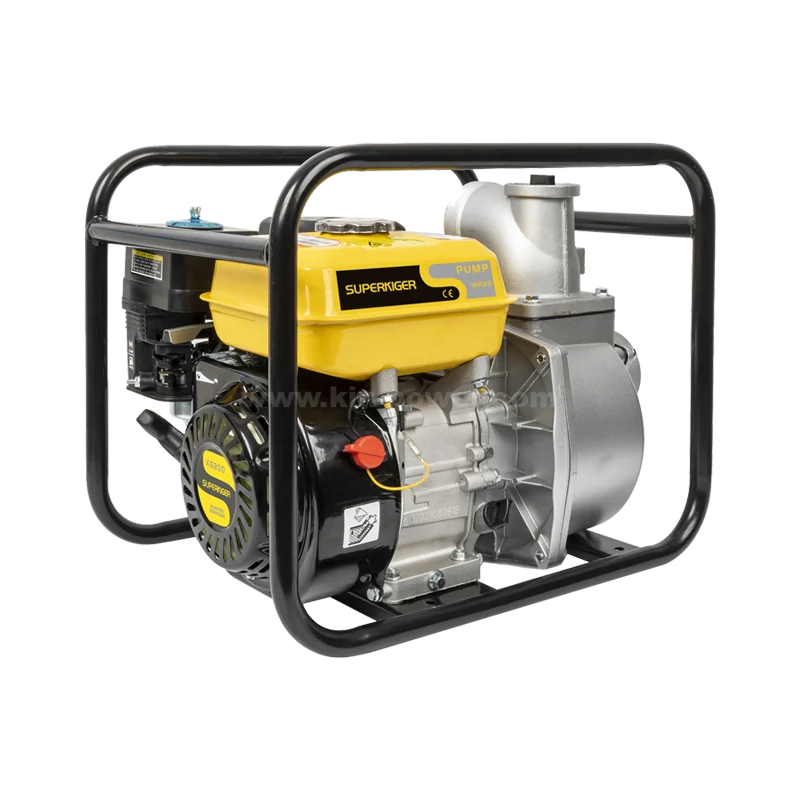
Total dynamic head — the pressure a water pump must actually work against — is the one calculation that decides whether a pump fits your job. It combines the vertical lift from the water source to the highest discharge point, the friction losses in your hoses and pipes, and any pressure you need at the discharge end. Add a 20% safety margin, compare the result against the pump’s maximum head and flow figures, and the size choice stops being guesswork. This guide walks through the formula step by step with a worked irrigation example.
Every KIGERPOWER pump page publishes two headline figures: maximum flow and maximum head. They are not a promise of what you get at once — a centrifugal pump delivers near maximum flow at low pressure and near maximum head at zero flow. The number that matters is the duty point: the flow and pressure your job actually requires, checked against the envelope of both figures.
Total dynamic head, step by step
Total dynamic head (TDH) is the total pressure the pump must generate. It has three components:
- Vertical lift — the height difference between the water level at the pump and the highest discharge point. A pump at canal level filling a tank 10 m uphill counts 10 m of lift, plus the height of the water column inside the tank while the pump is running.
- Friction losses — energy used to push water through the hose and pipe run. Friction grows with flow rate and with hose length, and it grows fastest when the diameter is small. Long, skinny hoses eat head; short, wide ones barely register.
- Discharge pressure — if you are feeding a sprinkler, a pressure irrigation line or a spraying rig, part of the head is pressure rather than height.
Add the three together, then apply the 20% safety margin to cover pipe fittings, elbows, valves, and conditions you did not measure. That final number is your required head.
Calculating the flow you need
Flow is simpler arithmetic: divide the total water volume by the time you have to move it, and apply the same 20% margin. Moving a 60 m³ pool in two hours means 30 m³/h of real flow; with margin, size for 36 m³/h. A canal that must deliver 40 m³ in an hour wants 48 m³/h of rated flow.
Worked example: canal irrigation
A pump sits at canal level and must deliver water 12 m uphill to a field, through about 100 m of hose at roughly 40 m3/h.
- Vertical lift: 12 m.
- Friction: moderate for a 100 m run at this flow — covered by the 20% margin on the lift, which brings the required head to about 15 m.
- Flow: 40 m³/h with margin, size for 48 m³/h.
Check the envelope: the WP30 offers 60 m³/h maximum flow and 28 m maximum head — both comfortably above the requirement. The WP20 offers 32 m head but only 36 m³/h flow, which is short of the required 48 m³/h. For this job the WP30 is the right fit.
Matching your numbers to the WP line-up
| Required head (with margin) | Required flow (with margin) | Model |
|---|---|---|
| up to 32 m | up to 36 m³/h | WP20 |
| up to 28 m | up to 60 m³/h | WP30 |
| up to 25 m | up to 75 m³/h | WP40A |
| up to 30 m | up to 90 m³/h | WP40B |
| up to 20 m | up to 140 m³/h | WP60 |
If your required head is above 32 m, the portable clear-water range ends and the high-pressure pumps take over: the WP20H reaches 65 m and the WP30H reaches 95 m, both for spraying and pressure irrigation duty. Every figure above is a maximum envelope value — your duty point must sit inside it, and longer or narrower hose runs push the required head up.
Why the wrong choice costs you
Oversizing — choosing a pump far above your duty point — runs the engine outside its efficient zone, wasting fuel per cubic metre pumped and shortening service intervals. Undersizing — trusting the flow figure while the required head is near the limit — collapses the duty point: the pump can no longer push the rated flow at that head, and you get a slow trickle instead of irrigation.
Two rules keep you out of both mistakes: put the pump at or near water level (never plan a suction lift deeper than the 7 m self-priming limit), and size the discharge run generously — wider hose beats longer hose every time.
For muddy or abrasive water, pair this calculation with the variant guide: trash pumps (WP20S, WP30S) for solids, chemical pumps (WP20C, WP30C) for aggressive liquids. All 28 models, gasoline and diesel, are on the water pump category page.
Related Engineering Guides & Product Catalog
- WP20 vs WP30 vs WP40: Choosing the Right Gasoline Water Pump
- Gasoline Water Pumps – A Guide
- How to Size a Generator for Inductive Motor Loads (Pumps & Compressors)
- Explore KIGERPOWER Complete Power Machinery Catalog
Frequently Asked Questions (FAQ)
Q1: How do I calculate total dynamic head when choosing a water pump?
Add three components — (1) the vertical lift from the water level at the pump up to the highest discharge point; (2) the friction losses in the hose and pipe run, which grow with length, flow rate and narrow diameters; and (3) any pressure head you need at the discharge end. Add a 20% safety margin to the total, then check the result against the pump’s maximum head and maximum flow figures — your duty point must sit inside both.
Q2: Can you give a worked example for a typical irrigation job?
A pump sits at canal level and must deliver water 12 m uphill to a field, through about 100 m of hose at roughly 40 m3/h. Vertical lift is 12 m; assuming moderate hose friction, the 20% margin brings the required head to about 15 m. The 3-inch WP30 (max head 28 m, max flow 60 m3/h) covers that duty point with plenty of headroom, while the 2-inch WP20 (max head 32 m, max flow 36 m3/h) would cover the head but is close on flow for this job.
Q3: What is the difference between suction lift and total head?
Suction lift is the distance from the water surface up to the pump — the side where the pump creates a vacuum to prime itself. All KIGERPOWER gasoline pumps are self-priming to a maximum of 7 m, so place the pump at or below water level and never plan a deeper lift. Total head is the discharge side: vertical height the water must reach, plus friction losses.
Q4: Does hose diameter really matter that much?
Yes. Friction losses grow quickly with flow rate and hose length, and shrinking the diameter is the fastest way to burn head. A long, small-diameter hose turns a small pump into a big one and a big pump into one that cannot reach its rated head — which is exactly why the 2-inch WP20 keeps a 32 m head rating while the 4-inch WP40A trades head (25 m) for volume (75 m3/h).
Q5: What if my required head is above 32 m?
The portable clear-water range tops out at the WP20’s 32 m head. For higher pressure duty, choose the high-pressure pumps: the WP20H delivers up to 65 m head and the WP30H up to 95 m head, both for spraying and pressure irrigation. For volume beyond 75 m3/h, the 4-inch WP40B and 6-inch WP60 carry the range.