 English
 中文
 Русский
 Deutsch
 Français
 日本語
 Indonesia
 Tiếng Việt
 ไทย
 العربية

WP20 vs WP30 vs WP40: Choosing the Right Gasoline Water Pump
Share to WeChat Moments
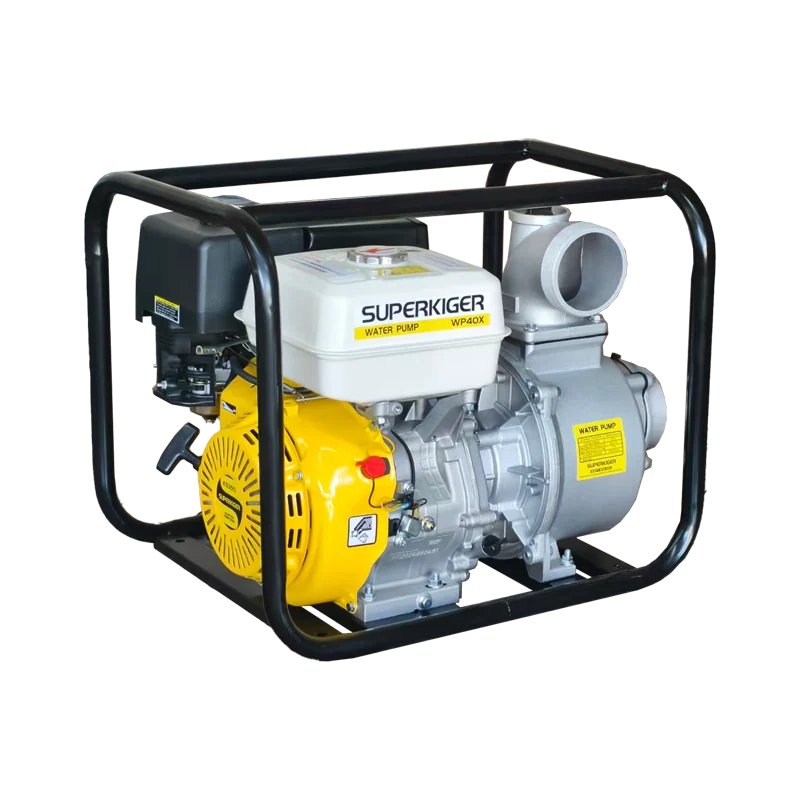
The WP20, WP30 and WP40 are KIGERPOWER’s three mainstream gasoline water pump sizes, and all three base models run the same 7 HP / 212 cc four-stroke engine. What changes with the size is the water end — 36, 60 and 75 m3/h of maximum flow at 32, 28 and 25 metres of head. This guide compares the three side by side and shows which duty point each size actually fits.
Because the engine is identical across the three base models, the buying decision is not about power. It is about how much water you must move, how far you must push it, and what the water carries. A 4-inch pump is not a “stronger” WP20 — it is a different trade between volume and pressure.
Spec comparison: WP20 vs WP30 vs WP40
Every figure below comes from the product page linked in each row:
| Model | Inlet & outlet | Max flow | Max head | Engine | Gross weight | Typical duty |
|---|---|---|---|---|---|---|
| WP20 | 50 mm (2") | 36 m³/h | 32 m | 7.0 HP / 212 cc | 21.3 kg | Portable irrigation, small drainage, long hose runs |
| WP30 | 80 mm (3") | 60 m³/h | 28 m | 7.0 HP / 212 cc | 22.5 kg | Flat-field irrigation, canal and pond transfer |
| WP40A | 100 mm (4") | 75 m³/h | 25 m | 7.0 HP / 212 cc | 27 kg | Flood drainage, bulk filling and dewatering |
| WP40B | 100 mm (4") | 90 m³/h | 30 m | 15.0 HP / 418 cc | 38.5 kg | 4-inch volume with extra lift, electric start |
| WP60 | 150 mm (6") | 140 m³/h | 20 m | 15.0 HP / 418 cc | 60 kg | Flood drainage and bulk transfer |
All five models share the same 7 m maximum suction lift, so every size can prime itself from a canal, tank or shallow sump below the pump.
What the size actually changes
Max flow and max head are two ends of one curve, not two numbers you get at once. At free discharge a pump approaches its maximum flow with little pressure; shut the flow down and it reaches maximum head. Your real duty point sits somewhere between the two, reduced further by hose friction and any elevation the water must climb.
That is why the WP20 stays in the line-up despite being the smallest: its 50 mm ports and impeller are wound for pressure, giving 32 m of head — the highest of the three base models. Push water up a slope, through 50 metres of hose or over a dike, and the WP20 keeps working where a 4-inch pump would run out of head.
The WP40A goes the other way. The 100 mm port passes more water with less restriction, so it empties a flooded field, a construction pit or a pond faster — but its 25 m head rating means long uphill runs are not its strength. The WP30 sits in the middle and is the most common single answer for irrigation.
Choosing by application
- Flat-field irrigation from a canal or pond — WP30: 60 m³/h covers most hourly irrigation budgets on one machine, and 22.5 kg gross is still a two-person lift.
- Long hose runs, hillsides and elevated tanks — WP20: 32 m head and the lightest package (21.3 kg gross) in the range.
- Flood drainage, pit dewatering, fast bulk transfer on flat ground — WP40A: 75 m³/h at 25 m head with the same 7 HP engine.
- 4-inch volume that also has to climb — WP40B: 15 HP lifts 90 m³/h to 30 m, with electric start and a 6 L tank for long unattended runs.
- Bulk work beyond 4 inch — WP60: 140 m³/h at 6 inches for flood drainage and large transfer jobs.
The variants: same three sizes, different wet ends
Every size class has duty-specific siblings, so the size decision above still applies after you know your water:
- Muddy or sandy water — trash pumps WP20S and WP30S, with cast-iron impellers and seals that pass solids a clear-water pump would destroy.
- Agricultural chemicals and liquid fertilizer — chemical pumps WP20C and WP30C.
- Spraying and pressure irrigation — high-pressure pumps WP20H (65 m head) and WP30H (95 m head).
- Hard, abrasive site water — cast-iron pumps WP20HCI and WP30HCI.
Diesel engines cover the same 1.5-inch to 6-inch sizes, including cast-iron and trash variants — all 28 pump models are on the water pump category page.
Related Engineering Guides & Product Catalog
- Gasoline Water Pumps – A Guide
- How to Size a Generator for Inductive Motor Loads (Pumps & Compressors)
- Explore KIGERPOWER Complete Power Machinery Catalog
Frequently Asked Questions (FAQ)
Q1: What is the difference between the WP20, WP30 and WP40 gasoline water pumps?
The port size and the duty envelope. All three base models share the same 7.0 HP / 212 cc air-cooled 4-stroke engine, but the WP20 has 50 mm (2") ports and moves up to 36 m³/h at 32 m head, the WP30 has 80 mm (3") ports and moves up to 60 m³/h at 28 m head, and the WP40A has 100 mm (4") ports and moves up to 75 m³/h at 25 m head. Smaller ports hold pressure for longer lifts; larger ports move more volume at lower head.
Q2: Which pump size do I need for flat-field irrigation?
Calculate the water volume you must move divided by the time you have, then add a 20% margin for pipe friction and fittings. Moving around 60 m³ of canal water in one hour puts you on the 3-inch WP30 (60 m³/h). Smaller plots and tank filling are comfortably handled by the 2-inch WP20, while flooded fields that must be drained fast are the 4-inch WP40A’s job.
Q3: Should I choose the WP40A or the WP40B?
Choose by head, not by price. The WP40A (7 HP, 75 m³/h at 25 m, 27 kg gross, recoil start) is the lighter high-volume pump for drainage and canal transfer on flat ground. The WP40B (15 HP / 418 cc, 90 m³/h at 30 m, 38.5 kg gross, electric start, 6 L tank) is for when 4-inch volume also has to climb — hillside fields, long discharge hoses or higher lift.
Q4: Do all three sizes lift water from the same depth below the pump?
Yes — the maximum suction lift is 7 m on every size, because suction lift depends on the engine-driven vacuum priming, not on the discharge port. Total head is the other half of the equation: vertical discharge height plus friction losses in the hose. That is where the WP20’s 32 m head rating earns its place on long or steep runs.
Q5: Which variant do I need if the water is muddy or aggressive?
The base WP20/WP30/WP40A models are clear-water pumps for clean water. For muddy or sandy water choose the trash pumps (WP20S, WP30S), for agricultural chemicals and liquid fertilizer the chemical pumps (WP20C, WP30C), for spraying and pressure irrigation the high-pressure pumps (WP20H at 65 m head, WP30H at 95 m) and for hard abrasive site water the cast-iron pumps (WP20HCI, WP30HCI). Diesel twins cover the same sizes on the water pump category page.