 English
 中文
中文 Русский
 Deutsch
 Français
 日本語
日本語 Indonesia
 Tiếng Việt
 ไทย
ไทย العربية
Hướng dẫn nhập khẩu máy phát điện từ nhà máy Trung Quốc: Đánh giá nhà máy, thử tải và đóng container 40HQ
By Kylin Lin, Senior Power Systems Engineer at Ningde Kinger Electrical Machinery Co., Ltd. (KIGERPOWER)
Published: September 2026 | Sourcing Category: Global B2B Power Equipment Procurement & Factory Verification
Executive Summary: Avoiding Costly Pitfalls in Chinese Power Sourcing
China manufactures over 70% of the world’s portable and commercial power generation equipment. For international equipment distributors, hardware retail chains, and commercial contractors, sourcing directly from Chinese manufacturing hubs offers unmatched economies of scale, flexible OEM branding, and cutting-edge soundproofing technology.
However, the Chinese power equipment export landscape is heavily fragmented. Importers frequently face significant risks: dealing with trading middlemen misrepresenting themselves as factories, receiving generators with inferior copper-clad aluminum (CCA) windings, encountering non-compliant emissions documentation that fails destination customs, and suffering high shipping costs from poorly packed containers.
This 2026 factory sourcing guide delivers a proven engineering and procurement checklist for international buyers sourcing diesel generators, gasoline sets, and water pumps from Ningde, Fujian—China’s premier power machinery export base.
1. The Ningde Power Cluster: Industrial Ecosystem Advantages
Located along the coast of Fujian Province, Ningde is internationally recognized alongside Taizhou (Zhejiang) and Chongqing as one of China’s core electrical and power machinery manufacturing powerhouses:
- Complete Upstream Supply Chain: Within a 30-kilometer radius, Ningde houses specialized Tier-1 component suppliers for engine blocks, high-precision forged crankshafts, silicon steel laminations, and digital AVR microchips.
- Port Logistics Proximity: Ningde’s deepwater coastal ports, combined with short feeder connections to Xiamen and Fuzhou container terminals, significantly reduce domestic trucking inland freight compared to inland provinces.
- Advanced Acoustic Canopy Manufacturing: Ningde has pioneered automated laser sheet-metal cutting and electrostatic outdoor powder-coating technology for silent diesel generator enclosures, setting the benchmark for weather-resistant acoustic canopies exported to tropical Africa and the Middle East.
2. Factory Audit Checklist: True Manufacturer vs. Assembly Middleman
Before remitting 30% production deposits, foreign buyers should insist on verifying physical manufacturing capabilities against this 5-point audit criteria:
| Audit Dimension | True OEM Manufacturer (e.g., KIGERPOWER 12,000m² Plant) | Assembly Workshop / Trading Middleman |
|---|---|---|
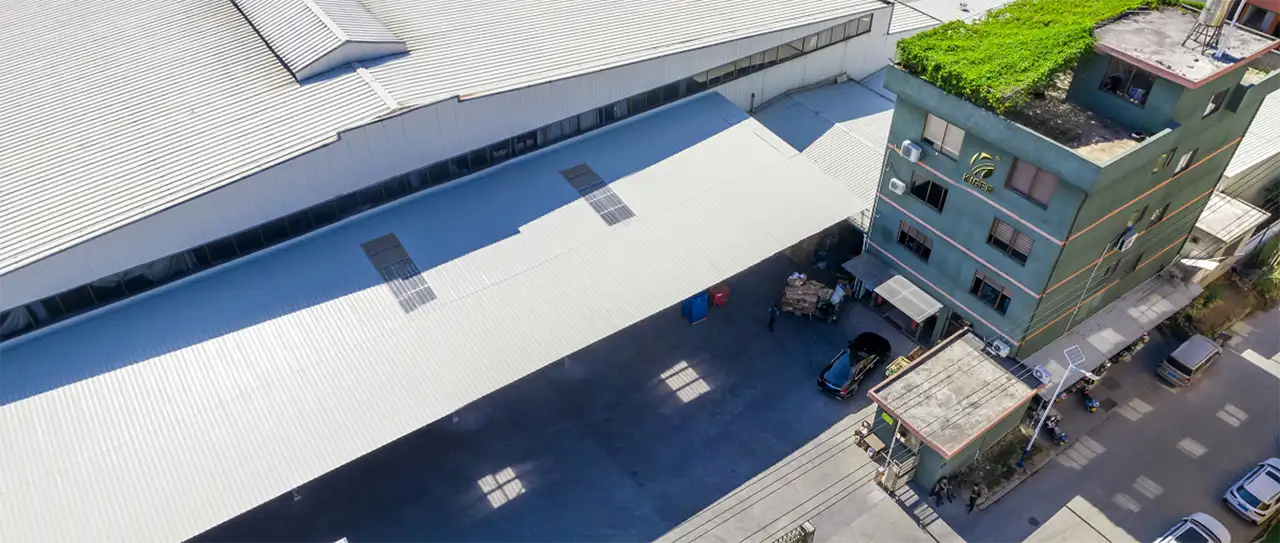
| Motor Winding Operations | In-house automated stator coil winding & VPI vacuum varnishing | Purchases pre-wound generic stators from external wholesale markets |
| Metalworking & Canopies | In-house CNC laser cutting, automated folding & powder-coating lines | Buys pre-painted sheet metal shells, prone to rust and poor fitment |
| Quality Control Testing | 100% computerized resistive load-bank testing line with digital reports | Spot checks 5%–10% of units without calibrated load banks |
| Regulatory Documentation | Direct holder of original CE, ISO 9001, and SONCAP Product Certificates | Uses third-party borrowed certificates or Photoshop-altered test reports |
| Traceability & Serial Tracking | Laser-engraved serial badges tracked in ERP database from assembly to ship | Stick-on paper serial numbers with no historical production traceability |
3. 100% Load-Bank Testing Protocol: Verifying Nameplate Power
Commercial-grade generators should never be approved for crating based merely on “idling tests” (running the engine with no electrical load). A true factory quality inspection requires computerized resistive load-bank testing:
+-----------------------------------------------------------------------------------+
| Factory Automated Load-Bank Testing Sequence (Standard 45-Minute Protocol)        |
+-----------------------------------------------------------------------------------+
| Stage 1: Cold Startup & Idle Run-in (0% Load)  - 5 Minutes (Check oil pressure & leaks)
| Stage 2: Low-Load Stabilization (25% Load)    - 5 Minutes (Verify initial voltage & Hz)
| Stage 3: Half-Load Continuous Run (50% Load)  - 10 Minutes (Thermal stabilization)
| Stage 4: Rated Prime Output (100% Load)        - 20 Minutes (Verify kW output & AVR stability)
| Stage 5: Peak Overload Surge (110% Load)       - 5 Minutes (Confirm governor response & reserve)
+-----------------------------------------------------------------------------------+
Essential Parameters Verified on Test Reports:
- Voltage Stability: Must remain within ±1.5% to ±2.5% of rated voltage from 0% to 100% load.
- Frequency Regulation: Must maintain 50 Hz ± 0.5 Hz (or 60 Hz ± 0.6 Hz) under steady-state operation.
- Low-Oil Automatic Shutdown: Sensor must reliably ground the ignition circuit within 3 seconds of oil level depletion.
4. 40HQ Container Mixing Strategy: Slashing Per-Unit Ocean Freight
Ocean freight for a 40-foot High Cube (40HQ) container represents a significant percentage of landed unit cost. Maximizing container space is the fastest way to increase retail profit margins:
- The Freight Dilemma: A 40HQ container provides approximately 68 to 76 cubic meters of usable volume and a maximum road cargo weight limit of 21,000 to 26,000 kg (depending on destination country axle laws).
- The Heavy-Light Mixing Solution:
- Silent diesel generators (such as the KG5000DE series, weighing ~150 kg each) are dense and reach the container weight limit when the container is only 60% full.
- Portable gasoline generators (such as 2kW–3kW models, weighing ~40 kg each) or gasoline water pumps are compact and fill volume without exceeding weight limits.
- The Optimal 40HQ Load: Position 54 to 72 heavy silent diesel sets on the lower deck, and stack 200 to 350 lightweight gasoline units or water pumps on the upper tier. This maximizes both the gross payload weight and total cubic volume, cutting landed shipping costs by up to 22% per kilowatt.
5. Customs Clearance Documentation Checklist
Ensure your supplier provides authentic, verified documents to avoid port detention:
- Clean on Board Bill of Lading (B/L): Must clearly specify container seal numbers and exact gross weights.
- Commercial Invoice & Detailed Packing List: Displaying exact engine serial numbers, net weights, and HS codes (e.g., 8502.20 for gasoline sets, 8502.11 for small diesel sets).
- CE Declaration of Conformity (DoC): Referencing Machinery Directive 2006/42/EC and EMC Directive 2014/30/EU.
- Country-Specific Compliance Certificates: SONCAP (PC/SC) for Nigeria, SASO for Saudi Arabia, or COC inspection certificates for East Africa.
Acoustic & Efficiency Reference: For decibel attenuation comparisons and fuel efficiency data across canopy models, see our Silent Diesel vs. Open-Frame Gasoline Generators Comparison.
Frequently Asked Questions (FAQ)
Q1: What is the difference between an in-house generator manufacturer and an assembly trading workshop in China?
A true manufacturing plant owns precision winding lines, laser sheet-metal cutting, and load-bank test rooms. Assembly workshops merely purchase cheap disparate parts from wholesale markets and assemble them by hand without calibrated quality control.
Q2: What specific electrical parameters should be recorded during a 100% load-bank verification test?
Voltage stability, frequency regulation, harmonic distortion (THD), and low-oil shutdown response. Voltage stability must remain within ±1.5% to ±2.5% from zero to full load.
Q3: How does mixing silent diesel generators and portable gasoline generators in a 40HQ container reduce freight?
It balances the container’s volume and weight limits simultaneously. Heavy diesel sets maximize payload weight on the floor, while lightweight gasoline units fill remaining upper volume, cutting ocean freight costs per unit by up to 22%.
Q4: What pre-shipment inspection options (PSI) are recommended before final payment?
Engage an authorized third-party inspection agency (SGS, Bureau Veritas, TUV) or request a high-definition real-time video audit. Inspect voltage stability, decibel noise levels, and packaging integrity before container sealing.
Author & Engineering Support (E-E-A-T)
Author: Kylin Lin
Title: Senior Power Systems Engineer at KIGERPOWER
Organization: Ningde Kinger Electrical Machinery Co., Ltd. (KIGERPOWER)
Expertise: Over 15 years in factory automation, automated load-bank testing protocols, and international container freight logistics.
To schedule an on-site factory visit, arrange a live video load test, or request 40HQ container loading calculations: [email protected] | KIGERPOWER Product Catalog