 English
 中文
 Русский
 Deutsch
 Français
 日本語
 Indonesia
 Tiếng Việt
 ไทย
 العربية

Cách tính công suất máy phát điện cho tải động cơ cảm ứng: Máy bơm, máy nén khí và điều hòa
Chia sẻ lên WeChat Moments
Executive Summary: The #1 Sizing Mistake in Commercial Power
The single most frequent cause of premature generator failure, nuisance tripping, and customer dissatisfaction is undersizing for electric motor startup current. Facilities managers often check the nameplate of a 3 HP drainage pump or a 5 HP air compressor, note that 3 HP equals approximately 2.2 kW, and conclude that a 3 kW generator is sufficient.
In reality, connecting that 3 HP pump to a 3 kW generator will cause the engine to immediately choke, drop engine RPM, and trigger the circuit breaker.
Electric motors do not behave like simple resistive heating elements or incandescent light bulbs. During the first few cycles of startup, an inductive electric motor creates an instantaneous electrical demand known as Locked Rotor Amperage (LRA), requiring 3x to 7x its normal running power.
This 2026 engineering guide provides electrical contractors, industrial equipment distributors, and site engineers with step-by-step mathematical formulas and a practical sizing matrix for matching commercial generators to heavy inductive loads.
1. Resistive vs. Inductive Loads: Understanding Inrush Current
All electrical appliances fall into one of two fundamental categories:
Resistive Loads (Unity Power Factor, PF = 1.0)
- Examples: Electric heaters, halogen work lights, toasters, curling irons.
- Characteristics: The electrical current is directly in-phase with voltage. There are no moving mechanical components or magnetic coils.
- Starting Requirement: Starting watts equal running watts (1:1 ratio). A 2,000W heater requires exactly 2,000W of generator capacity.
Inductive Loads (Lagging Power Factor, PF = 0.8)
- Examples: Submersible water pumps, reciprocating air compressors, concrete mixers, HVAC chillers, power saws.
- Characteristics: Utilizes copper electromagnets to create rotating magnetic fields. Current lags behind voltage.
- Starting Requirement: Requires an initial burst of reactive magnetizing current to establish the magnetic flux and overcome mechanical inertia from a standstill. This inrush current lasts from 50 milliseconds to 3 full seconds.
$$\text{Starting Surge Watts} = \text{Running Watts} \times \text{Starting Multiplier (2.5x to 7x)}$$
2. NEMA Motor Code Letters & Starting Multipliers
The National Electrical Manufacturers Association (NEMA) assigns code letters (from A to V) to motor nameplates, defining the kilovolt-amperes required per horsepower with locked rotor:
| Motor Starter Type | Starting Multiplier | Inrush Current vs. Full Load Current | Application Examples |
|---|---|---|---|
| Direct-on-Line (DOL) - Standard | 3.0x – 6.0x | 500% – 700% of FLA | Submersible pumps, air compressors, table saws |
| Capacitor-Start Induction Motor | 4.0x – 7.0x | 600% – 800% of FLA | Heavy refrigeration compressors, pressure washers |
| Star-Delta Starter (Y-Δ) | 2.0x – 3.0x | 200% – 300% of FLA | Large workshop machinery, ventilation blowers |
| Electronic Soft-Starter | 1.8x – 2.5x | 200% – 250% of FLA | Commercial water pumps, industrial conveyors |
| Variable Frequency Drive (VFD) | 1.0x – 1.2x | 100% – 120% of FLA | Modern elevators, precision industrial pumps |
3. Commercial Sizing Matrix: 1 HP to 10 HP Motors
Below is the verified engineering sizing table for commercial electric motors running at standard 230V single-phase or 400V three-phase (0.8 Power Factor, DOL Starter):
| Electric Motor Rating | Running Watts (kW) | DOL Starting Surge (kW) | Minimum Generator Capacity (Direct-on-Line) | Minimum Generator Capacity (With Soft Starter / VFD) |
|---|---|---|---|---|
| 0.5 HP (370 W) | 0.45 kW | 1.8 kW | SUPERKIGER KG2500 (2.0 kW Gasoline) | 1.0 kW Inverter Generator |
| 1.0 HP (750 W) | 0.90 kW | 3.6 kW | SUPERKIGER KG5000DE (5.0 kW Silent Diesel) | 2.0 kW Generator Set |
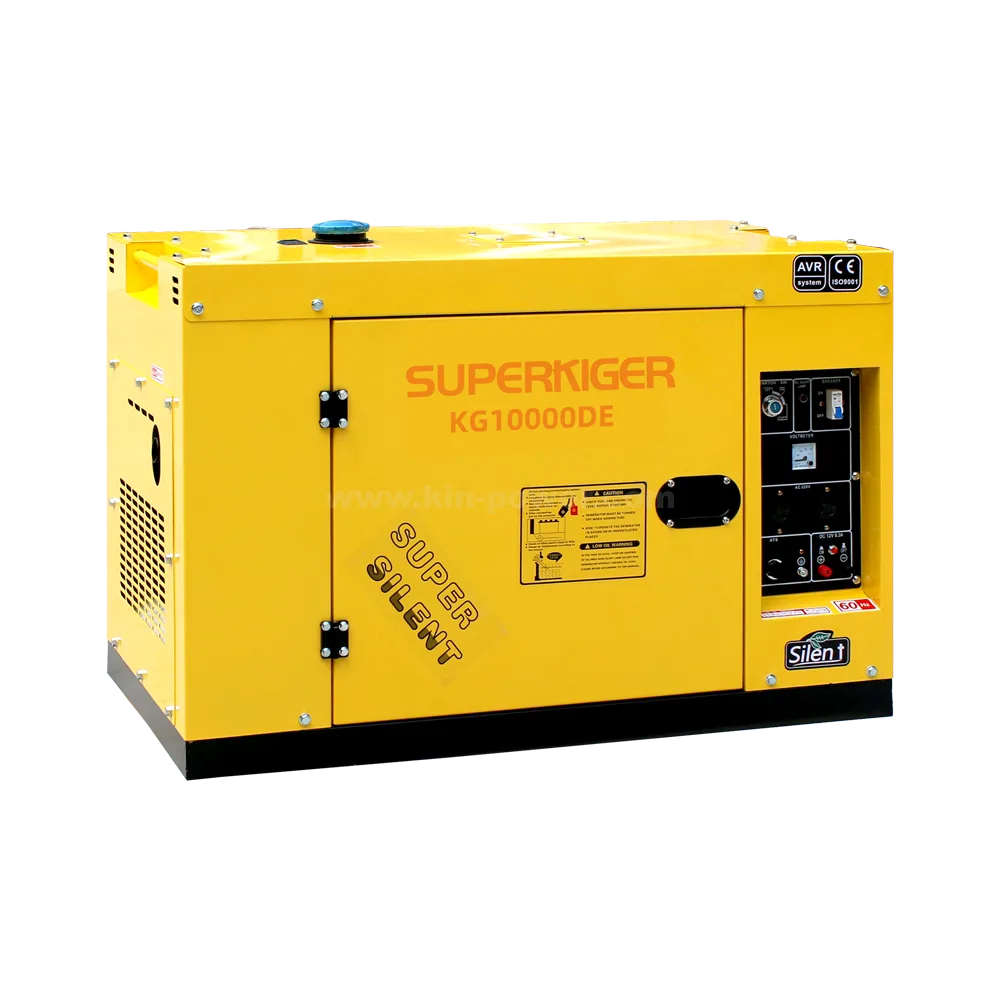
| 2.0 HP (1.5 kW) | 1.80 kW | 7.2 kW | SUPERKIGER KG10000DE (8.0 kW Silent Diesel) | 4.0 kW Generator Set |
| 3.0 HP (2.2 kW) | 2.60 kW | 10.5 kW | SUPERKIGER KG13000E / KG15000DE (10–12 kW) | 5.5 kW Generator Set |
| 5.0 HP (3.7 kW) | 4.40 kW | 17.5 kW | SUPERKIGER 18–20 kW Commercial Diesel | 8.0 kW Generator Set |
| 7.5 HP (5.5 kW) | 6.50 kW | 26.0 kW | SUPERKIGER 25–30 kW Industrial Diesel | 12.0 kW Generator Set |
| 10.0 HP (7.5 kW) | 9.00 kW | 36.0 kW | SUPERKIGER 40–50 kW Industrial Diesel | 16.0 kW Generator Set |
4. Alternator Subtransient Reactance & AVR Performance
When an electric motor suddenly starts, the generator’s terminal voltage drops instantly. The depth of this voltage dip is governed by the alternator’s Subtransient Reactance (X"d):
- Cheap Alternators (High X"d > 18%): Experience voltage dips exceeding 30%. Magnetic starter contactors drop out, the motor stalls, and equipment resets.
- SUPERKIGER Commercial Alternators (Low X"d < 12%): Heavy copper winding geometry with low internal impedance limits instantaneous voltage drop to under 15%, allowing the motor to accelerate smoothly to rated RPM without tripping control circuits.
Furthermore, SUPERKIGER diesel generators feature high-excitation digital AVR systems that supply up to 300% field forcing current for 10 seconds during sudden inductive shock loads.
Factory Verification: Sizing heavy motor loads requires authentic generator reactance. Learn how we verify low subtransient reactance on our testing line: China Generator Factory Sourcing & Load-Bank Testing Guide. For pump sizing, see our Gasoline Water Pumps Sourcing Guide.
For custom motor starting calculations or three-phase commercial power sizing: [email protected] | SUPERKIGER Product Catalog
Câu hỏi thường gặp
Tại sao máy bơm nước điện 2 HP (1,5 kW) lại cần máy phát điện 5 kW hoặc 6 kW để khởi động?
Động cơ điện cảm ứng cần dòng khởi động gấp 3 đến 7 lần dòng chạy định mức (FLA) trong 0,5 đến 2 giây đầu tiên (dòng khóa rô-to LRA). Dù công suất chạy chỉ 1,5–1,8 kW, công suất đỉnh lúc đề-pa vọt lên tới 5,0–7,2 kW. Máy phát nhỏ hơn sẽ bị sụt áp nghiêm trọng hoặc chết máy.
Sự khác biệt giữa kW và kVA khi tính chọn máy phát điện cho tải động cơ là gì?
Kilowatt (kW) là công suất tác dụng thực tế, còn kilovolt-ampere (kVA) là công suất biểu kiến bao gồm cả công suất phản kháng từ hóa cuộn dây. Động cơ điện thường có hệ số công suất (cos φ) khoảng 0,8, nên máy phát phải đáp ứng đủ cả kW lẫn kVA.
Bộ khởi động mềm (Soft-Starter) hoặc biến tần (VFD) có giúp giảm công suất máy phát cần mua không?
Có. Khởi động trực tiếp (DOL) tạo dòng xung kích tới 600%. Khởi động mềm giới hạn dòng đề-pa ở mức 200%–250%, còn biến tần (VFD) giữ dòng khởi động chỉ 100%–120%, giúp giảm tới 50% công suất máy phát điện yêu cầu.
Mạch ổn áp tự động AVR kỹ thuật số ngăn máy phát chết máy khi đề-pa mô-tơ như thế nào?
Khi mô-tơ cảm ứng khởi động làm điện áp tụt xuống, bộ AVR kỹ thuật số tốc độ cao lập tức tăng dòng kích từ vào rô-to củ phát trong vài mili-giây, kéo điện áp đầu cực lên trước khi khởi động từ (contactor) bị nhả.